
Viele von euch kennen meinen Fotoscout aus dem Jahr 2018 — das Buch, das damals beim dpunkt.verlag erschien und ein Jahr später eine zweite Auflage erlebte. Ich habe mich damals über jede Rückmeldung gefreut, und viele dieser Rückmeldungen haben mich seitdem begleitet.
Eine englische Ausgabe war lange ein Gedanke, der im Hinterkopf schlummerte — zu naheliegend, um ihn loszuwerden, aber auch zu aufwändig, um ihn nebenbei anzugehen. Als ich die Rechte zurückerhalten hatte und nach einem Projekt suchte, das ich ganz nach meinem eigenen Tempo gestalten konnte, war die Entscheidung eigentlich schnell gefallen.
Jetzt ist es fertig. Eine englischsprachige Neuausgabe — erweitert, neu strukturiert und vollständig überarbeitet. Lofoten Photography — Under Arctic Light · Lofoten & Senja ist mehr als eine Übersetzung. Es ist das Buch, das ich heute schreiben würde.
Der Rest dieses Artikels ist auf Englisch — weil das Buch auf Englisch ist, und weil ich hoffe, damit auch die internationale Fotografen-Community zu erreichen, die die Lofoten seit Jahren begeistert. Wer lieber auf Deutsch mehr erfahren möchte: schreibt mir einfach.
Lofoten Photography — Under Arctic Light · Lofoten & Senja
A Photographer’s Guide to Lofoten & Senja · Now Available
There is a car park in Hamnøy, right at the water’s edge, that I have visited more times than I can count. Red rorbuer built hard against the rocks. Mountains rising straight from the fjord. A scene that works in every light, every season — and produces something different every time.
It was on one of those early morning visits, standing at the edge of that car park with a group of workshop participants, that I first thought seriously about writing a guide to the Lofoten in English. Not a translation. A guide written for photographers who don’t read German — and who deserve the same depth of information that readers of the German edition have had since 2018.
Although the German edition found its readers quickly — a second edition followed in 2020 and a French edition came out with Éditions Eyrolles — people who didn’t read German kept writing to ask whether an English version was on the way.
The Making of This Guide
Making it happen took longer than expected. For years I had been in conversations with my German publisher about an English edition, but the discussions never led anywhere. So earlier this year I called my editor and asked for the rights back. He said yes.
And from that moment, the book took shape quickly. Not because the work was easy, but because I had been preparing for it without quite realising it. Twenty workshops on the Lofoten. Trips in January darkness and October storms. Four visits to Senja in autumn. And years of returning to the same locations in different conditions.
While the Lofoten is well known to landscape photographers worldwide, nevertheless the depth of local knowledge needed to photograph it well takes years to build. That accumulation is what this guide tries to pass on.
It launches on the 21st of June — the summer solstice. Around this time of year, the sun never dips below the horizon on the Lofoten. The light just shifts, hour after hour, through gold and rose and back again. Although the solstice feels like a peak, it is also a turning point: from that day, the nights begin to return. Above the Arctic Circle, moreover, that change comes faster than most people expect. A book about Arctic light felt right to launch at exactly this hinge between the two.
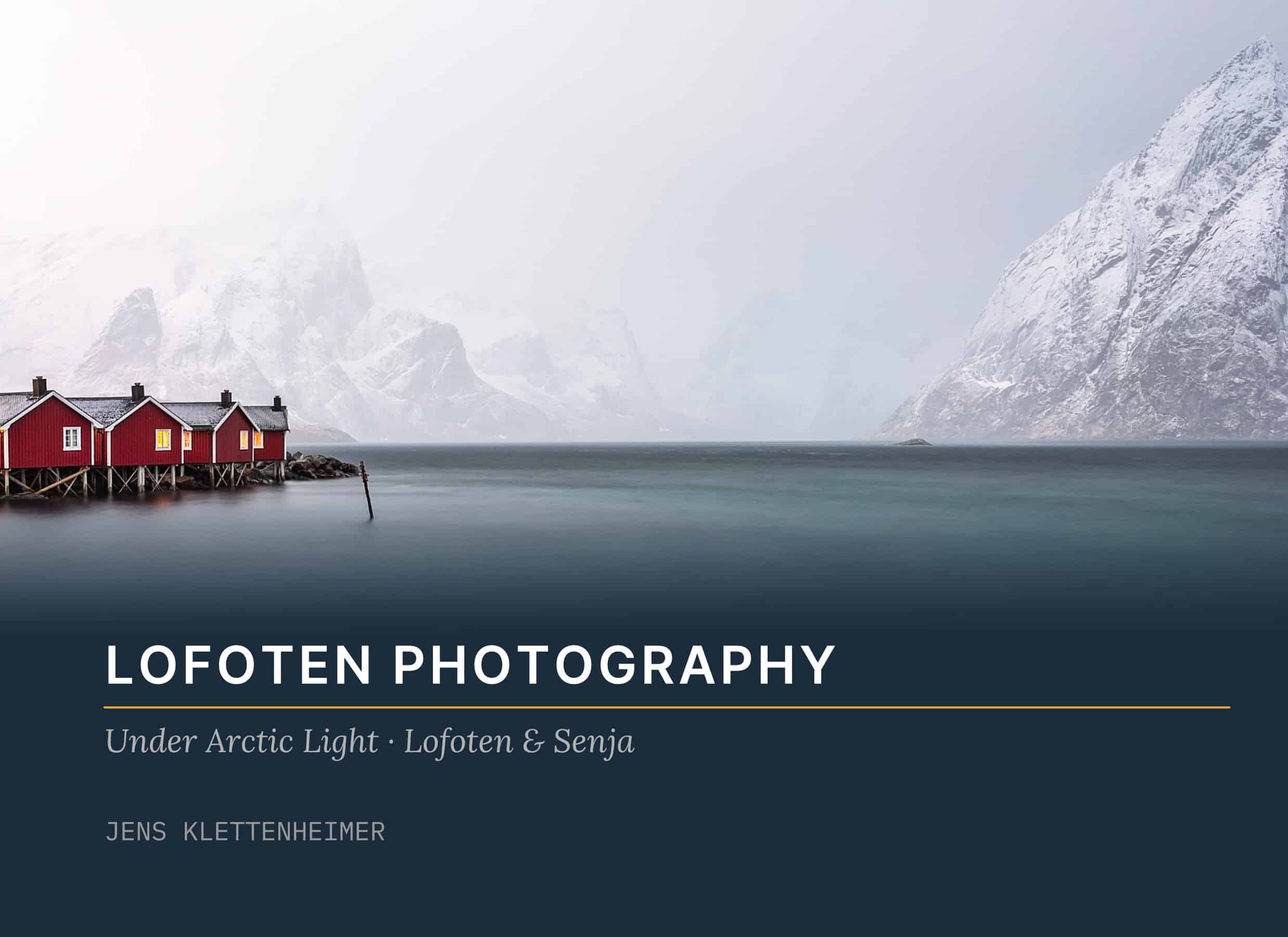
Lofoten Photography — Under Arctic Light · Lofoten & Senja is the English edition — but it isn’t simply a translation. While the original guide was organised as a series of driving tours, this edition is arranged by island, which makes more sense for how most photographers actually plan and use a guide like this. The structure is different, the coverage is expanded, and a number of locations have been updated or replaced. The spot count has grown from roughly 40 to 86 carefully selected photo locations across Lofoten and Senja.
What the Book Covers
The guide works its way through the islands from north-east to south-west, following the natural direction of arrival for most visitors.
Austvågøya — The largest island and the gateway to the archipelago. Seven spots, from the sheltered waters of Austnesfjorden to the famously improbable football pitch at Henningsvær.
Gimsøya — Small, quiet, and easy to underestimate. Three spots, including the beach church at Gimsøysand with its steel-cable bracing against the Atlantic wind — one of the most distinctive subjects on the islands.
Vestvågøya — The central island, and the one I keep returning to most. Twenty-one spots, from the surf beach at Unstad to the mirror-flat waters of Urefjorden. Leknes, the most practical base for exploring all of Lofoten, is here.
Flakstadøya — Fourteen spots across one of the most photographically rewarding stretches of the archipelago: the beaches at Ramberg and Kvalvika, the rorbu village at Nusfjord, the wide sweep of Skagsanden under a winter sky.
Moskenesøya — Twenty spots from Fredvang to Å, the southernmost village in Lofoten. Reine, Hamnøy, Bunes — landscapes that photographers have been travelling thousands of kilometres to reach for decades, and with good reason.
Senja — A full chapter on Norway’s second-largest island, some 200 kilometres north-east of the Lofoten. Although Senja has been Norway’s best-kept secret for landscape photographers for a long time, it is increasingly drawing attention. Dense birch forest, deep fjords cut by peaks approaching 1,000 metres, and far fewer visitors than the Lofoten — it rewards the extra journey.


The Web Companion
Every spot in the book has a corresponding page on schieflicht.de. A QR code printed in the margin of each spot page links directly to it. The companion site carries an interactive map with all locations, current notes, and any updates since the book went to press. Access to the full spot map and list is via the QR codes in the book.
A Note on This Edition
The German original was published by dpunkt.verlag, although the English rights are held by me. This is an independent publication — written, designed, and self-published by schiefLicht Fotografie. If you’ve read the German edition and are wondering whether this one is worth it: the coverage is substantially broader, the structure is cleaner, and the companion app is new.
How to Get the Book
Lofoten Photography — Under Arctic Light · Lofoten & Senja is available as a print edition via Amazon and as a PDF eBook directly from schieflicht.de. All formats, current prices, and ordering options are on the book page.